
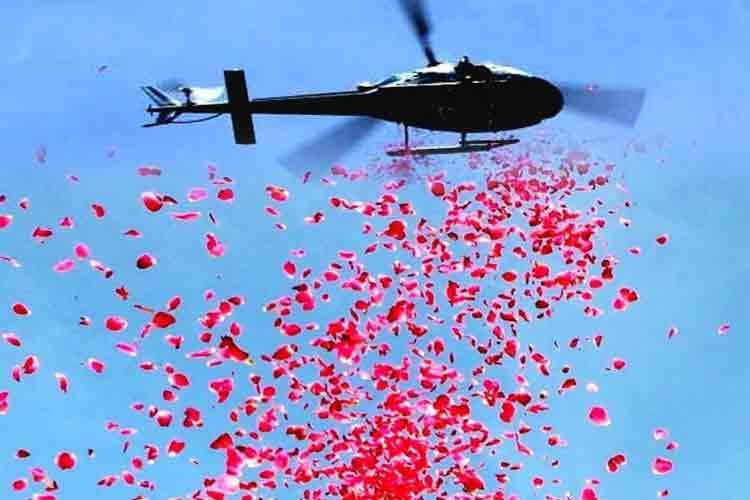
Picture the moment: music swells across the wedding lawn, hundreds of guests look skyward as the unmistakable thump of rotor blades draws closer, and a shower of fresh rose and marigold petals drifts down over the procession before the helicopter touches down just steps from the red carpet.
In India, weddings have always celebrated grandeur, tradition, and unforgettable hospitality. While vintage cars and royal processions remain timeless, a helicopter wedding entry paired with aerial flower dropping (Pushp Varsha) has become one of the most sought-after highlights for destination weddings, palace celebrations, and luxury farmhouse events.
Yet behind a three-minute aerial spectacle lies weeks of careful aviation planning. Unlike booking a band or a banquet hall, chartering a helicopter involves airspace clearances, local district permissions, site feasibility checks, and weather contingencies. At FlexAir Aviation, we manage specialized Helicopter for Wedding and Helicopter Flower Dropping charters across major hubs including Delhi NCR, Dehradun, Mumbai, Pune, and destination venues nationwide. Here is everything couples, families, and wedding planners need to know to execute a safe, seamless, and show-stopping wedding flight.
Popular Ways to Incorporate a Helicopter Into Your Wedding
Every wedding schedule has its own rhythm, and a private helicopter charter can be tailored to fit the exact ceremony you want to elevate.
- The Royal Baraat or Groom Arrival: Instead of navigating congested wedding traffic, the groom—often accompanied by close family members—flies directly from a nearby city airport or helipad to the wedding venue. Stepping out of a helicopter in full wedding attire creates an instant, cinema-scale entrance.
- Aerial Flower Dropping (Pushp Varsha): Whether timed with the arrival of the baraat, the exchange of garlands at the varmala stage, or a temple blessing, a dedicated flower-dropping sortie hovers at a regulated safe altitude to release hundreds of kilograms of fresh petals over the venue.
- Post-Wedding Vidai or Couple Transfer: Turning the traditional farewell into an extraordinary memory, the newlyweds depart together by air—either transferring smoothly to a nearby airport for their honeymoon or arriving together at the reception venue.
- Private Pre- or Post-Wedding Couple Joyride: For couples who want a quiet, breathtaking moment above the festivities, a 15-to-20-minute scenic circuit offers panoramic views of palaces, coastlines, or Himalayan foothills.
Permissions & Aviation Clearances in India
The biggest misconception about wedding helicopters is that booking the aircraft is the only step. In India, civil aviation is strictly regulated to protect passengers, wedding guests, and surrounding neighborhoods. Every non-scheduled wedding landing or low-altitude flower drop requires coordinated clearances.
- DGCA Compliance & Flight Plan Approval: All commercial charter operations must follow Directorate General of Civil Aviation (DGCA) safety norms, with approved flight plans filed through Air Traffic Control (ATC) before takeoff.
- District Administration & Police NOCs: When landing at a temporary helipad—such as a resort lawn, open ground, or farmhouse—local authorities must sign off. This typically includes a No-Objection Certificate (NOC) from the District Magistrate (DM) or Collector’s office, local police station clearance for crowd management, and fire and ambulance standby verification.
- Written Venue Permission: The resort, hotel, palace, or private landowner must issue formal written consent permitting a helicopter landing or low-level fly-past on their property.
Navigating aviation paperwork while managing wedding invitations and catering can quickly overwhelm families. FlexAir Aviation handles end-to-end feasibility assessments and coordinates directly with your wedding planner and local authorities to streamline approvals well ahead of the wedding date.
Venue & Helipad Requirements: Can a Helicopter Land at Your Venue?
Not every open lawn is automatically ready for a touchdown. Before confirming a landing charter, aviation operations teams evaluate the venue against strict technical criteria:
- Landing Zone Dimensions & Surface: Depending on the helicopter model, a temporary helipad typically requires a flat, firm clearing measuring 30m × 30m to 60m × 60m. Loose sand, freshly watered lawns, or uneven soil must be stabilized or matted so rotor downwash does not kick up debris or dust clouds toward guests.
- Obstacle-Free Approach & Departure Paths: Pilots need clear, unobstructed angles to descend and climb safely. High-tension overhead power lines, tall trees, mobile towers, giant wedding trusses, and floodlight poles around the perimeter are carefully inspected during a pre-event site survey.
- What If Your Venue Cannot Host a Landing? Lack of landing space does not mean giving up on the aerial experience. In dense city venues or heritage properties with tight courtyards, you can still book an aerial flower dropping sortie. The helicopter operates from the nearest approved airport or helidrome, performs a planned fly-past to shower petals over your celebration, and returns to base without needing to land on-site.
Step-by-Step Planning Timeline for a Stress-Free Experience
Because peak wedding dates in India—especially between November and February, and during spring destination seasons—overlap with high demand for corporate and pilgrimage charters, early scheduling is essential.
2 to 3 Months Before the Wedding
Lock in your wedding date, venue coordinates, and preferred helicopter hub (such as Dehradun, Delhi, Mumbai, or Pune). Share approximate passenger counts so your charter team can recommend the right single-engine or twin-engine aircraft.
3 to 4 Weeks Before the Wedding
Complete the physical site inspection of the landing zone and submit the documentation package for DM, police, and venue NOCs. If you are adding Pushp Varsha, finalize your flower selection—fresh rose, marigold, and jasmine petals work best because they flutter gracefully and remain lightweight when properly cleaned and de-stemmed.
1 Week Before the Wedding
Synchronize the flight schedule with your wedding planner, sound team, and photographers. Because airspace traffic and weather dictate exact departure windows, plan around a 30-to-45-minute arrival window rather than an exact-to-the-minute muhurat. Also coordinate with your photography team so any wedding drones are grounded well before the helicopter enters the area—drones and helicopters must never share the same airspace.
On the Wedding Day
Ground crew teams arrive early to mark the helipad, install a windsock, set up barricades, and position fire extinguishers. Once pre-flight weather checks are cleared, the aircraft departs on cue for your grand arrival.
Safety Protocols & Weather Contingencies
A truly memorable wedding entry is one where every guest feels safe and comfortable. Following a few non-negotiable protocols keeps the event running like clockwork:
- Strict Perimeter Control: Guests, photographers, and family elders must stay behind a 50-meter safety barricade until the helicopter has landed, the pilot has signaled clearance, and the main rotor blades have come to a complete stop.
- Securing Loose Decor & Attire: Helicopter downwash generates strong gusts. Lightweight floral arches, loose carpets, helium balloons, and unsecured tent canopies near the landing pad should be weighted down or placed well clear of the zone. Brides, grooms, and guests greeting the aircraft should also secure heavy dupattas and safas.
- Weather Readiness: North Indian winter mornings (especially around Delhi NCR and Dehradun) can bring dense fog, while coastal and hill regions can experience sudden crosswinds or cloud cover. Always maintain a decorated luxury vehicle on standby as a seamless Plan B in case visibility drops below safe VFR (Visual Flight Rules) limits.
What Determines the Cost of a Wedding Helicopter & Flower Shower?
Every wedding charter is custom-quoted because no two flight paths or venues are identical. Rather than a flat rate, pricing is calculated transparently based on four main factors:
- Flying Hours & Positioning Distance: Charters are billed primarily by total engine/flying hours, including ferry time from the nearest operational base (such as Sahastradhara Helidrome in Dehradun, or bases in Delhi, Mumbai, and Pune) to your venue and back.
- Aircraft Type & Seating Capacity: A nimble 4-seater helicopter suited for a solo groom arrival or flower drop costs less per hour than a larger 6-seater executive twin-engine helicopter carrying multiple family members.
- Single Sortie vs. Combined Operations: Combining a passenger arrival with a dedicated aerial flower-dropping pass requires additional hover time and petal-loading logistics.
- Ground Setup & Permissions: Temporary helipad marking, ground marshalling staff, NOC facilitation, and bulk fresh flower petal procurement are factored into your final package.
Frequently Asked Questions (FAQs)
How early should we book a wedding helicopter in India?
Ideally, book 6 to 12 weeks in advance, especially for auspicious peak-season dates between November and March. Early booking secures aircraft availability and leaves ample time for District Magistrate and police NOCs.
Can the bride and groom fly together in heavy wedding outfits?
Yes. Modern charter helicopters easily accommodate the bride and groom together. However, because every aircraft has a strict maximum takeoff weight limit, your charter coordinator will ask for accurate passenger weights—including heavy bridal lehengas, sherwanis, and hand luggage—before confirming the manifest.
How many kilograms of flower petals are needed for an aerial shower?
Most wedding flower showers use between 100 kg and 400 kg of fresh petals, depending on the size of the guest gathering and how many passes you want the helicopter to make. Petals must be fresh, dry, and completely free of stems, thorns, or hard buds.
Can we fly drones to film the helicopter landing?
No. For strict aviation safety reasons, all wedding drones must be grounded and powered off at least 30 minutes before the helicopter arrives and until it has departed the area. Your ground photography and videography team can capture stunning angles from behind the safety perimeter.
Make Your Wedding Arrival Unforgettable with FlexAir Aviation
Your wedding day deserves a centerpiece moment that guests will talk about for decades. Whether you are planning a grand baraat touchdown in Delhi NCR, a scenic Himalayan celebration in Dehradun, or a luxury destination wedding near Mumbai or Pune, FlexAir Aviation brings precision aviation management and personalized hospitality to every flight.
Ready to check if your wedding venue qualifies for a helicopter landing or aerial flower shower? Contact FlexAir Aviation today or call +91 8004008835 / 9389213255 with your wedding date, venue location, and requirements for a complimentary feasibility check and customized charter quote.